
How To Defend Your Final Year Project: A Practical Guide To The Viva
Your project is written, bound and submitted, and now one thing stands between you and graduation: the defence. For most students it is the most nerve-wracking hour of final year, not because the work is weak but because nobody ever teaches you how a viva actually works. The good news is that a defence is a discussion, not an interrogation, and it follows a pattern you can prepare for step by step. This guide walks you through it, from knowing your own project cold to answering the question you do not know.
Academic Integrity & Digital Research Tools
Writing a high-quality Project Thesis requires more than just data; it requires precision. To ensure your Research Methodology meets international standards, we recommend using advanced AI Plagiarism Checkers and Grammar Correction Software before submission.
Professional Proofreading and Formatting
Many academic institutions now use automated AI Detection Tools. If you are preparing your Statement of Purpose (SOP) or Manuscript, investing in professional Academic Proofreading Services can help you maintain a high Similarity Index score while ensuring your research remains authentic and impactful.
First, Understand What the Viva Is Testing
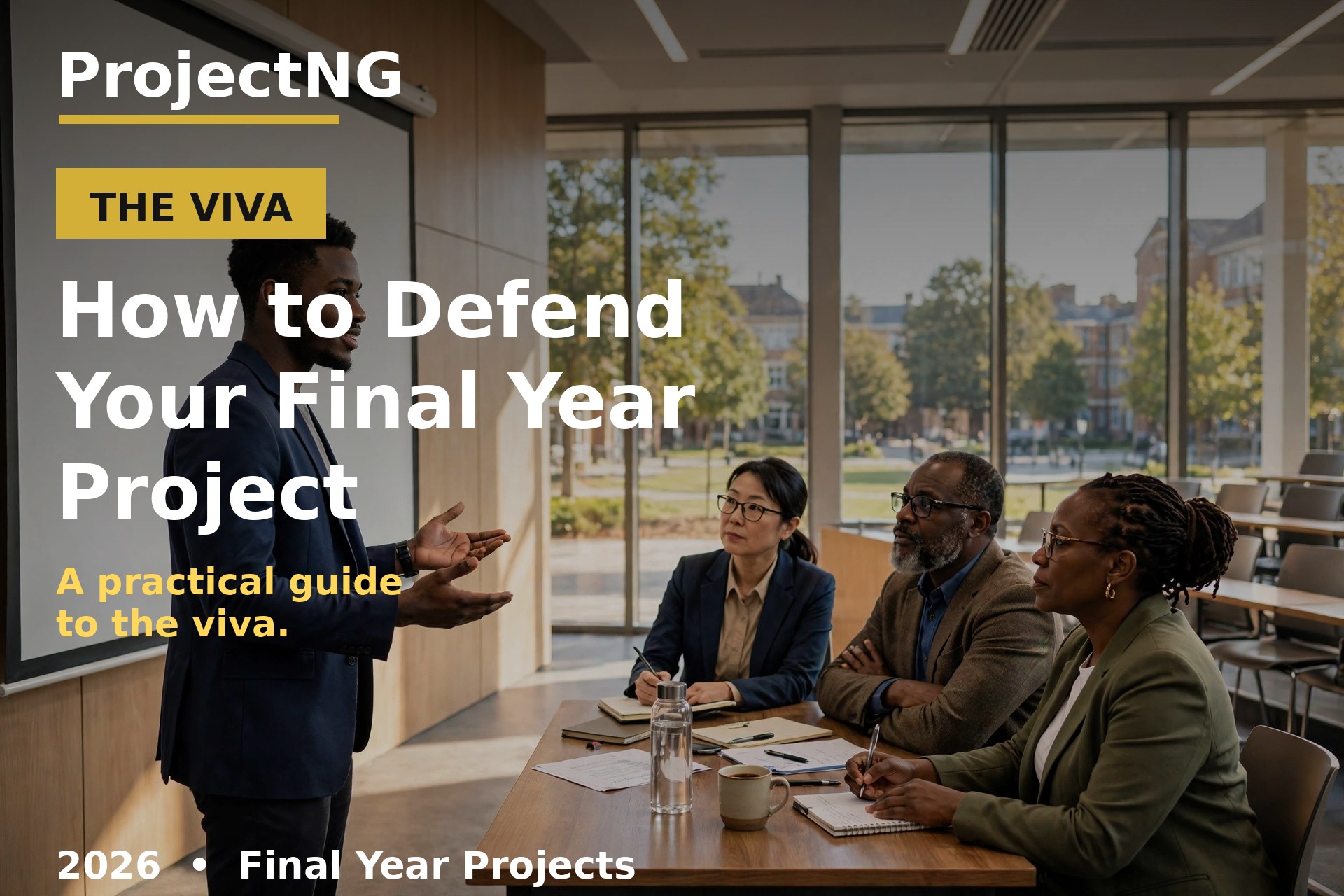
A viva, short for viva voce, is an oral examination where you present a summary of your research to a panel and answer their questions. The panel usually includes your supervisor, an internal examiner from your department, sometimes an external examiner from another institution, and a chairman who moderates. Most undergraduate defences allow 10 to 15 minutes for the presentation and 15 to 20 minutes for questions.
Here is what most students do not realise: the panel wants you to pass. They have already read your work and decided it is worth defending. In the room they are checking three things only: that the work is genuinely yours, that you understand the decisions behind it, and that you can explain it clearly to people who have not lived inside it for months. Every question they ask is one of those three checks in disguise. For a wider look at how examiners think, see this guide to final year project presentation and defence best practices.
Step 1: Know Your Project Cold, Especially the Why
Start by re-reading your own report from cover to cover. You would be surprised how many students stumble on questions about their own work simply because they have not looked at it since submission. Know your problem statement, your objectives, your method, your main results and your limitations without opening the document.
Then go one level deeper, because the viva is not a quiz about what you did, it is a defence of why you did it that way. For every major choice in your project, write one honest sentence that explains it:
- Why this research design? Your question needed this approach, and here is the approach you rejected and why. If you are still unsure how designs differ, read our guide on how to choose the right research design for your final year project.
- Why this sample? Know your population, your sample size and how you chose it. Our guide on how to determine sample size for your final year project covers the numbers examiners will ask about.
- Why this method of collecting data? A questionnaire, an interview or an observation each answers a different kind of question, so be ready to say why yours fits. Our guide on how to write research questions and hypotheses will help you connect your questions to your method.
- Why this analysis? Know which tests or themes you used and what each one showed, not just the software you clicked.
The single most viva-proof sentence you can learn is: "We compared X and Y, and X won because..." Naming the alternative you rejected shows the panel you thought, not just followed instructions. If you genuinely cannot justify a choice, say so honestly and say what you would choose with a free hand. Examiners detect invented justifications instantly, and honesty about a constraint earns more marks than a clever-sounding bluff.
Step 2: Build a Short Talk That Tells One Story
Your presentation should tell the story of your research in 10 to 12 slides, one idea per slide, in 10 to 15 minutes. A simple structure that works for most defences is: the problem, your aim and objectives, your method, your key findings, your contribution to knowledge, and your conclusion with recommendations. Keep the words on each slide short and let your voice carry the detail. Our guide on how to prepare PowerPoint slides for project defense gives you the full slide-by-slide structure, design rules and rehearsal plan, so this article will not repeat it here.
If your project has a system, a prototype or a working demo, the demo is the most convincing part of your defence and also the most fragile. Script it as a short user story and rehearse it exactly as you will run it. Then record a full backup video of the demo working, because projectors fail, Wi-Fi drops and laptops die at the worst moments. If the live demo fails in the room, stay calm, say what it was meant to show, and switch to the recording. Examiners judge how you recover, not whether the technology behaved.
Step 3: Prepare for the Questions You Can Predict
Viva questions follow a pattern. They usually track the order of your report, from problem to method to results, and most of them are variations on a short list. Write a 60 to 90 second answer for each of these before the day, and rehearse them out loud:
- What problem does your project solve, and why did you choose this topic? State the problem, who faces it and what happens today without your solution. Give one practical reason and one academic reason, never "because my supervisor suggested it".
- Why did you choose this research design? Explain what the design is, why it suits your objectives, and what it cannot claim. A survey shows association, not causation, and saying so shows maturity.
- How did you determine your sample size? Know the figure and the reasoning behind it without looking at your notes.
- What is your most significant finding, and what does it mean? This is the difference between reporting a result and interpreting it. Our guide on how to interpret your research findings shows how to move from numbers to meaning.
- What is your contribution to knowledge? State plainly what is new about your work. If your contribution slide is vague, your whole defence feels vague.
- What are the limitations of your study? Name two or three honestly, and say which ones future research could fix. Our guide on how to write the significance, scope and limitations of your study will help you frame them.
- What would you do differently with more time or money? This is a favourite because it tests whether you learned from the work. Have a real answer ready.
- What is the significance of your study? Say who benefits from your findings and how, in concrete terms, not in grand claims about transforming national policy.
For more worked examples of common viva questions and model answers, see this guide to preparing for a final year project viva. Use other people's answers only as patterns, never as scripts to memorise, because a follow-up question will expose an answer that describes work you did not do.
Step 4: Learn the Honest Answer for Questions You Cannot Answer
Every student gets at least one question they cannot answer. What matters is not the gap in your knowledge but how you handle it. Use this four-move structure for any answer, and it will carry you through most questions:
- The answer, in one sentence. Say the point first, then stop and let the panel follow up if they want more.
- The reason. Why is that the answer? What logic or evidence supports it?
- The evidence from your project. Point to your own data, your own table, your own test result.
- The limit. Say what your answer does not cover. "The trade-off is that this questionnaire alone cannot establish a causal explanation for the responses" is a strong, honest finish.
When you genuinely do not know, say so plainly and then reason from what you do know. Two sentences that examiners respect are: "I do not know, but here is how I would find out," and "That was outside the scope of my study because..." Both show thinking, and both invite the panel to move on. What examiners penalise is guessing, bluffing, or blaming your supervisor, your teammates or your department. A wrong answer you invented is far worse than an honest "I don't know".
Also, take your time. When a question lands, pause for a few seconds before you begin. Ask the examiner to repeat or clarify the question if you need to, and repeat it back in your own words to check you understood it. A confident pause is worth more than a rushed paragraph, and the panel is measuring whether your answer is considered, not how fast it arrives.
Step 5: Rehearse Like It Is the Real Thing
Rehearsal is where a good project becomes a good defence, and silent reading does not count. Run at least one full mock defence before the day:
- Rehearse aloud, standing up, with a stopwatch. A talk you have never presented aloud will always run longer than you expect. Aim to finish at least one minute inside your limit so nerves or a slow projector do not cut off your conclusion.
- Rehearse in front of people. Present to friends, coursemates or family members and ask them to question you afterwards. Their questions will reveal the weak spots in your argument before the examiners find them.
- Rehearse your answers, not just your talk. After each practice run, write down every question you were asked and prepare short, honest answers. The questions that stump you in the mock are exactly the ones to prepare before the real thing.
- Rehearse with your actual equipment. Test your slides on the laptop and projector you will use, or at least on a similar setup. Save your slides as a PDF as well as a PowerPoint file, keep a copy on a flash drive and in your email, and print handouts so you can present without a projector if you have to.
If you are defending as a group, rehearse together. Examiners deliberately ask each member about someone else's part of the project, so every member should be able to explain every component well enough to describe its design and purpose, even if only the owner knows the implementation details.
Step 6: Handle Nerves on the Day
Nerves are normal, and the panel expects them. What they watch is whether you can recover, and the recovery itself is part of what they are grading. Three small techniques help more than any pep talk:
- Breathe slowly before you start. Inhale for four seconds, exhale for six, three rounds. The long exhale slows your heart rate within about thirty seconds.
- Plant your feet. Both feet flat on the floor, evenly weighted. It sounds trivial, but it steadies you when you are standing to present.
- Know your first sentence by heart. Nerves steal openings. If your first sentence is automatic, the rest of the talk follows.
Arrive at least thirty minutes early, test the projector, and confirm your slides display correctly. Bring water, a pen and a notepad so you can write down questions during the session. Speak slowly, make eye contact with the panel, and remember that a defence is a conversation about work you know better than anyone else in the room. If your mind blanks mid-answer, say "Let me think for a second", breathe, drink some water, and start again. The committee will wait. For more on calming defence anxiety, see this guide to FYP presentation and viva preparation and this guide to writing and defending a final year project.
Mistakes That Cost Marks
- A memorised script. It sounds robotic, and it collapses at the first unexpected question. Know your points, not your lines.
- Reading your slides word for word. The panel can read. Your job is to explain, interpret and answer questions.
- Guessing instead of admitting you do not know. A bluffed answer invites a follow-up you cannot survive.
- Blaming other people. Never blame your supervisor, your teammates or your department for a weakness in the work. Own it and say what you would do differently.
- Claiming more than your evidence supports. If your data cannot prove causation, do not claim it. Examiners check claims against evidence.
- Going over time. The panel may stop you before your conclusion, so finish inside the limit every time you rehearse.
Your One-Week Countdown to Defence Day
- Seven days before: re-read your full report and write one honest sentence for each major choice you made, including the alternative you rejected.
- Five days before: finalise your 10 to 12 slides and record your demo backup video.
- Three days before: run your first full mock defence with a timer and an audience.
- Two days before: run a second mock, fix the answers that felt weak, and prepare your backup files and printed handouts.
- One day before: check your equipment, pack your bag, and sleep properly. A tired brain cannot defend anything well.
- On the day: arrive early, breathe, speak slowly, and trust the preparation you have already done.
The viva is the last step of your final year project, not a separate exam you have to survive on talent alone. If you know your why and your how, keep your talk short and honest, prepare for the predictable questions, and answer the unpredictable ones with honesty, you will walk out of that room having shown the panel exactly what they came to see: a student who did the work, understands it, and can stand behind it.





RELATED TOPICS
Imsu Industrial Chemistry Project Topics And MaterialsUnical Marketing Project Topics And Materials
Oau Library And Information Science Project Topics And Materials
Abu Zaria Cooperative Economics Project Topics And Materials
Uniport Science Lab Technology Project Topics And Materials
Bsu Political Science Project Topics And Materials
Vuna Education Project Topics And Materials
Osu Education Project Topics And Materials
New Hospitality Management And Technology Project Topics And Materials
Osu Industrial Relation And Personnel Management Project Topics And Materials
12
Enjoying our content?
Don't miss out on new videos! Subscribe to our YouTube channel for more awesome content.
Subscribe Now!