
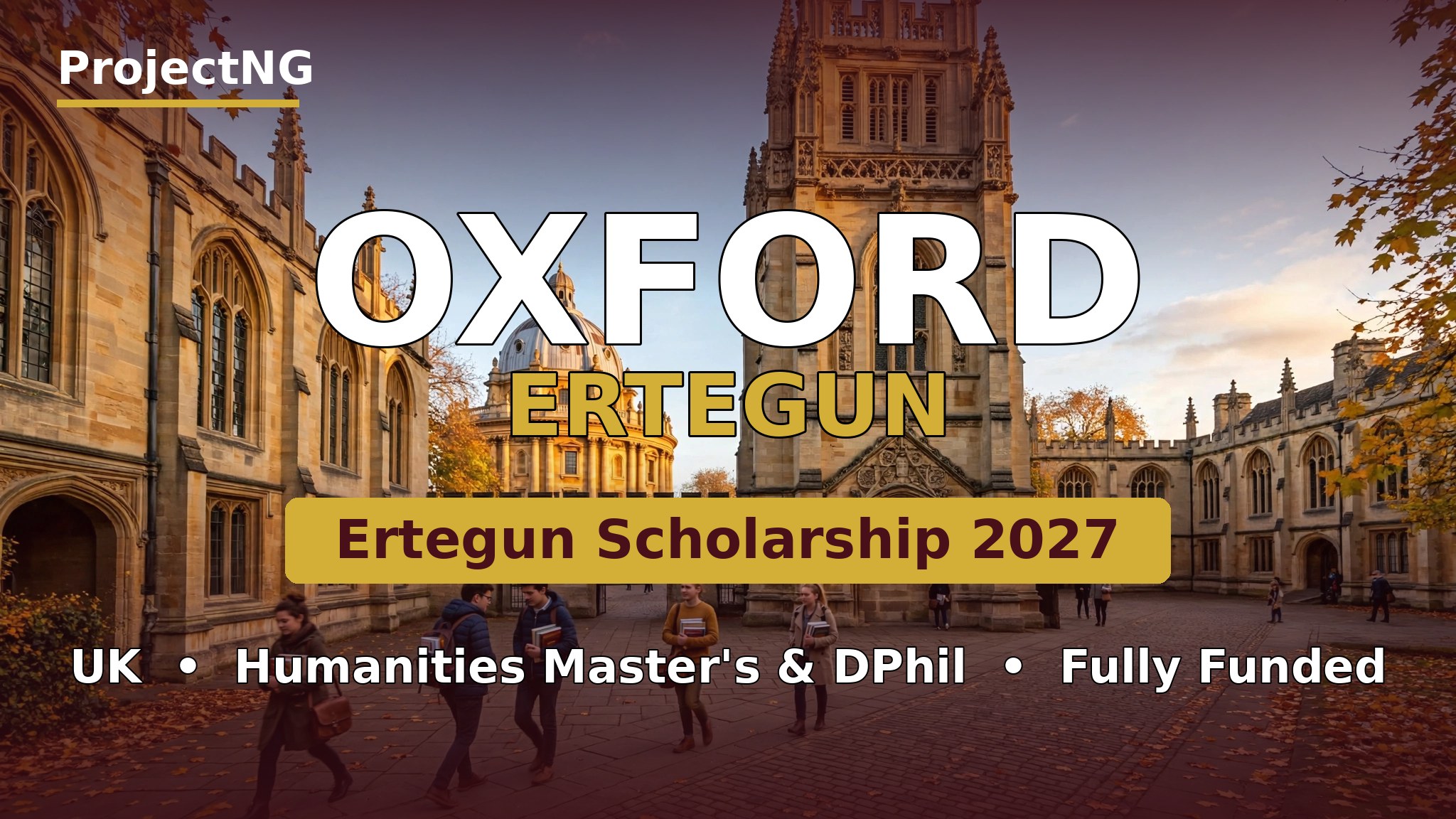
Ertegun Scholarship 2027 At Oxford: Fully Funded Humanities Master's And Dphil
What would you do with a year, or three, at Oxford, with every fee paid and a generous living grant in your pocket? If you study the humanities, that question is not a daydream. It is the Ertegun Scholarship, and for 2027 entry the window is open right now. But here is the catch that trips people up every year: the deadline is not one date. It is your course's early January deadline, and for many humanities courses that means 12:00 midday UK time on Tuesday 5 January 2027.
2026 International Student Financial Guide
Securing a Fully Funded Scholarship is only the first step. Many Nigerian students are now utilizing No-Cosigner Student Loans through providers like MPOWER Financing and Prodigy Finance to cover living expenses in the USA, Canada, and the UK.
Proof of Funds & GRE Waivers
If you are applying to Ivy League or Russell Group Universities, look for programs offering Graduate Assistantships. Many top-tier universities are currently granting GRE and GMAT Waivers for African applicants with strong professional backgrounds or high GPAs from recognized institutions.
WES Evaluation and English Tests
For Canada and the US, a WES Course-by-Course Evaluation is often mandatory. Additionally, if your degree was taught in English, you may qualify for an IELTS/TOEFL Waiver, saving you significant costs during the Graduate Admissions process.
The Mica and Ahmet Ertegun Graduate Scholarship Programme in the Humanities is one of the most generous awards Oxford offers. Around 15 scholarships are awarded each year, chosen from more than 1,500 applicants, and every one of them covers your course fees in full plus a living-cost grant. The grant for 2026-27 is £21,805 a year, which the programme says is normally enough to cover the living costs of a single student in Oxford. The 2027-28 rate has not been published yet, so treat that figure as the current published rate and check the official page before you apply.
What the Ertegun Scholarship covers
Every Ertegun Scholarship covers your course fees in full for the whole duration of your course, and adds an annual grant for living costs. The award lasts for the full length of your fee liability, with continuation each year subject to satisfactory academic progress. Scholars also get dedicated use of Ertegun House, a beautiful space in the heart of Oxford for writing and research, along with lectures, performances and social occasions arranged specially for scholars. It is a small, close community, and that is part of the point: the programme is looking for people who will one day become leaders in their fields.
One thing to know upfront: an Ertegun Scholarship may not be held together with any other award, and it is only for students starting a new full-time graduate course. Current Oxford graduate students can apply only if they are applying to start a new course.
Who can apply for the Ertegun Scholarship?
Students from all countries and all backgrounds are welcome, including UK students. There are no nationality or subject restrictions beyond the course itself. What matters is that your course is eligible. Only courses administered by Oxford's Humanities Division and its faculties qualify, with a small number of exceptions. The eligible faculties are Asian and Middle Eastern Studies, Classics (including classical archaeology), English Language and Literature, Fine Art (DPhil in Contemporary Art History and Theory only), History (including History of Art and the History of Architecture), Linguistics, Philology and Phonetics, Medieval and Modern Languages, Music, Philosophy, and Theology and Religion.
Several interdisciplinary courses also qualify, including Celtic Studies, Comparative Literature and Critical Translation, Medieval Studies, Film Aesthetics, Women's, Gender and Sexuality Studies, and Digital Scholarship. A handful of courses in the Oxford School of Global and Area Studies are eligible too, such as the MPhil and MSc in Japanese Studies, Modern Chinese Studies, Modern South Asian Studies and Modern Middle Eastern Studies, and the MPhil, MSt and DPhil in Classical Archaeology.
The rule is simple: if your course is not on the programme's eligible courses list, it is not eligible, so check that list on the official Ertegun page before you spend time on an application. You must also meet the entry requirements for your course, including the English language requirements.
The deadline: early January 2027, and it depends on your course
This is the detail to get right. The Ertegun Scholarship follows the early January deadline, with the exception of the Oxford School of Global and Area Studies courses listed above. Each humanities course has its own deadline, so the date that matters is the one for the course you are applying to. For many humanities courses, that deadline is 12:00 midday UK time on Tuesday 5 January 2027, for example the MSt in English (1900-present). Other courses may differ, so confirm your own course deadline on the Oxford graduate admissions pages and treat that as your Ertegun deadline. If your course uses another deadline and you want to be considered for Ertegun funding, you must still submit in time for the early January deadline.
Competition is fierce. With over 1,500 applicants for around 15 awards, the success rate is about 1.5% for Master's candidates and 1.3% for doctoral candidates. That is not a reason to hold back, it is a reason to prepare your application properly, especially the supporting statement.
How to apply for the Ertegun Scholarship 2027
There is no separate scholarship application form. You apply for the scholarship at the same time as you apply to Oxford, through the University's Graduate Application Form. Follow these steps:
- Choose an eligible course. Check the eligible courses list on the official Ertegun Scholarships page and confirm your course is on it.
- Check your course deadline. Find your course on the Oxford Graduate Admissions website and note its early January deadline, for many courses 12:00 midday UK time on 5 January 2027.
- Start your graduate application. Complete the University's Graduate Application Form for your chosen course.
- Select the scholarship. In the Funding section of the form, select "Ertegun Graduate Scholarships in the Humanities".
- Write your supporting statement. Answer the three questions that relate to the aims and mission of the Ertegun programme. Guidance is available on the official Ertegun page.
- Upload the statement as a PDF. Upload it together with your Graduate Application Form by the application deadline. Your scholarship application cannot be reviewed without it.
- Submit everything by the deadline. It is best to submit all your material at once.
If your statement is not ready when you submit your course application, you can exceptionally upload a placeholder statement saying you will provide your Ertegun statement for the January deadline, then send the completed statement to Graduate Admissions by the deadline, stating your full name, course details and student number. Do not leave this to chance: without the supporting statement, the Selection Committee cannot consider you.
What happens after you apply
Shortlisted candidates are first identified by their faculty, then nominated to the Ertegun Scholarships Selection Committee, which includes the Head of Oxford's Humanities Division and a representative from each eligible faculty. As part of the process, you will be interviewed by a faculty representative, usually by video call or telephone, and the interview is your chance to expand on the topics in your supporting statement. Successful candidates are notified by email. The programme expects the first round of offers to be issued by the end of March, with the selection process completed by the end of April.
Unsuccessful applicants are not contacted individually because of the volume of applications, so if you do not hear from the programme, your application to the scheme has been unsuccessful.
Is the Ertegun Scholarship for you?
If you are starting a new full-time Master's or DPhil in the humanities at Oxford in 2027, and your course is on the eligible list, the answer is yes. Full fees, a living grant of £21,805 at the current published rate, a dedicated house of your own in Oxford, and a community built around the humanities: very few scholarships offer this much. The competition is steep, but somebody has to win those 15 places, and the winners are the applicants who treat the supporting statement as seriously as the course application itself.
Start with the official page, check your course is eligible, confirm your course deadline, and get that statement written. The January deadline will arrive faster than you think.
Apply here: Ertegun Graduate Scholarship Programme in the Humanities, University of Oxford
Course deadlines and graduate applications: Oxford Graduate Admissions
Be the First to Share On Social




RELATED SCHOLARSHIPS
List Of African Government ScholarshipsOnline Scholarships You Can Apply For Today
How To Combine Work And Study Abroad
How To Secure Partial Scholarships
York President's International Scholarship 2027 Canada
Fully Funded Scholarships For International Students
How To Apply For Scholarships: A Step-by-step Guide To Funding Your Education
How To Combine Part-time Work And Scholarships Abroad
Cdu Vice-chancellor Scholarship 2027: 50% Off Tuition
Ellison Scholars Programme 2027: Fully Funded Oxford
15
Enjoying our content?
Don't miss out on new videos! Subscribe to our YouTube channel for more awesome content.
Subscribe Now!