
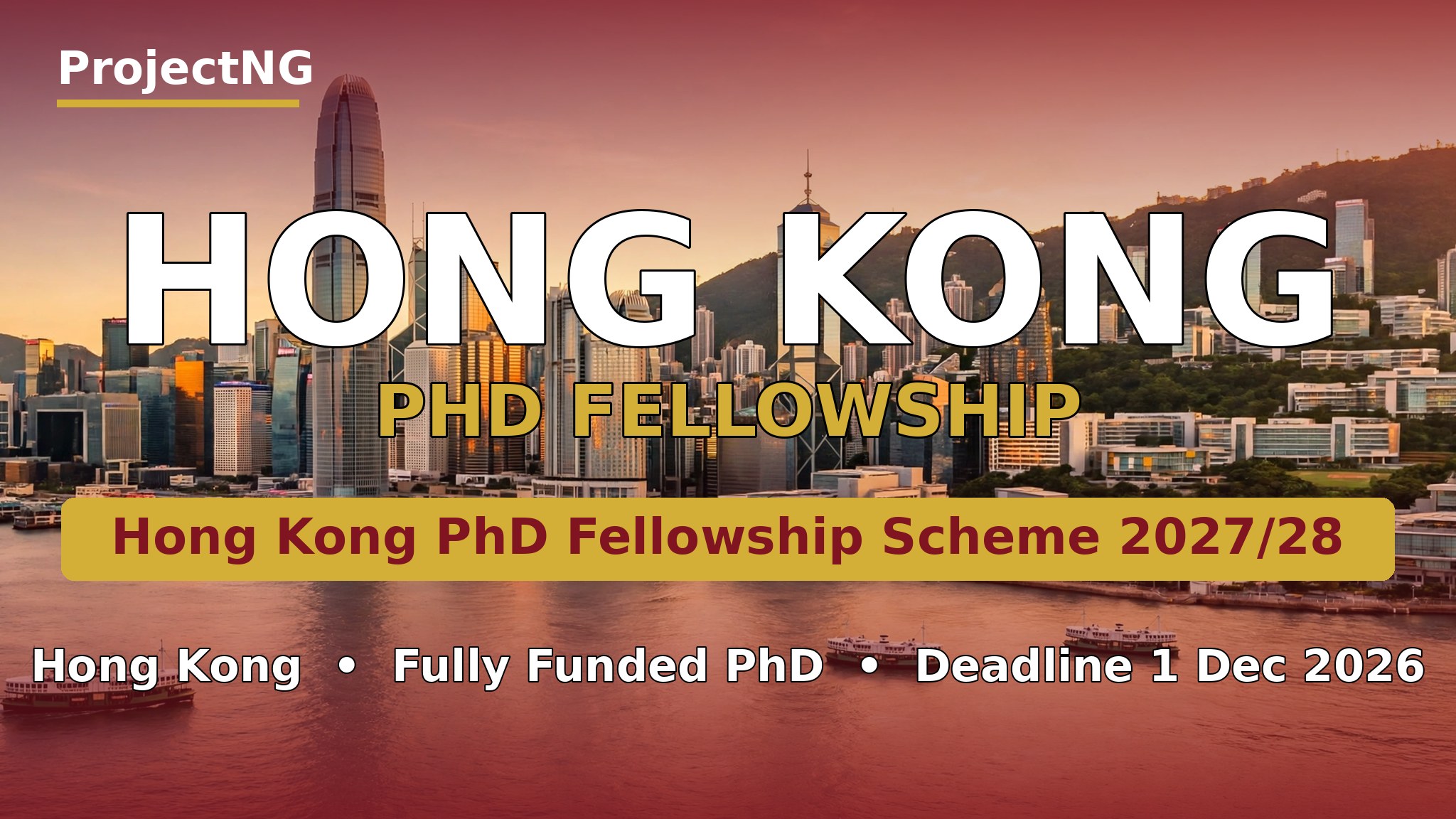
Hong Kong Phd Fellowship Scheme 2027/28: Fully Funded Phd In Hong Kong
The Hong Kong PhD Fellowship Scheme 2027/28 is open, and it is one of the most generous fully funded PhD scholarships in Asia. Run by the Research Grants Council (RGC) of Hong Kong, the scheme will award 400 fellowships for PhD study starting in the 2027/28 academic year, and the application is a two-step process with a single hard deadline: 1 December 2026. If a funded PhD in Hong Kong is on your list, this guide walks you through exactly what to do, in order, so you do not miss a step.
2026 International Student Financial Guide
Securing a Fully Funded Scholarship is only the first step. Many Nigerian students are now utilizing No-Cosigner Student Loans through providers like MPOWER Financing and Prodigy Finance to cover living expenses in the USA, Canada, and the UK.
Proof of Funds & GRE Waivers
If you are applying to Ivy League or Russell Group Universities, look for programs offering Graduate Assistantships. Many top-tier universities are currently granting GRE and GMAT Waivers for African applicants with strong professional backgrounds or high GPAs from recognized institutions.
WES Evaluation and English Tests
For Canada and the US, a WES Course-by-Course Evaluation is often mandatory. Additionally, if your degree was taught in English, you may qualify for an IELTS/TOEFL Waiver, saving you significant costs during the Graduate Admissions process.
What the Hong Kong PhD Fellowship Scheme Covers
Each Hong Kong PhD Fellowship Scheme awardee receives an annual stipend of HK$344,400 (about US$44,150), which works out to HK$28,700 per month, plus a conference and research-related travel allowance of HK$14,400 (about US$1,840) per year. The support runs for up to three years. If your PhD needs more than three years, your chosen university may provide additional support, so check with the university directly. Some universities add their own top-ups on top of the fellowship package. At the University of Hong Kong, for example, 2027/28 HKPFS holders also receive the HKU Presidential PhD Scholarship, which adds a cash award and a waiver of composition fees.
Who Can Apply for the Hong Kong PhD Fellowship
You are eligible if you are seeking admission as a new full-time PhD student at one of the eight participating universities, regardless of your country of origin, prior work experience or ethnic background. The eight universities are City University of Hong Kong, Hong Kong Baptist University, Lingnan University, The Chinese University of Hong Kong, The Education University of Hong Kong, The Hong Kong Polytechnic University, The Hong Kong University of Science and Technology, and The University of Hong Kong.
Selection is competitive. While academic excellence is the primary consideration, the selection panels also weigh your research ability and potential, your communication and interpersonal skills, and your leadership abilities. Shortlisted applicants are reviewed by one of two panels: Sciences, Medicine, Engineering and Technology, or Humanities, Social Sciences and Business Studies.
How to Apply for the Hong Kong PhD Fellowship Scheme 2027/28
There are two steps, and both must be completed. The first step alone is not enough, and the second step cannot happen without the first.
- Read the official Guidance Note first. Download the Guidance Note for Applicants 2027/28 from the RGC and read it carefully before you start. The RGC may stop processing an application that does not meet its requirements.
- Submit your initial application to the RGC. Go to the HKPFS Electronic System and complete the initial application before 1 December 2026 at 12:00 noon Hong Kong Time. Late submissions will not be considered. The system times out after 30 minutes of idling and unsaved entries are lost, so have your details ready before you log in.
- Choose up to two programmes. In the initial application, you pick up to two programmes or departments at one or two universities. You can change your choices until the deadline, but only the two choices saved when the deadline closes will be processed. No changes are accepted after that.
- Save your HKPFS Reference Number. Once you submit, a reference number in the form PF26-xxxxx is generated and emailed to you with your login password. Save and print that email. You must quote this reference number in every application to your chosen universities and in all correspondence with the RGC.
- Submit a full application to each chosen university. Apply to your chosen university or universities through their own online systems, quoting your HKPFS Reference Number, before each university's deadline. For 2027/28, all eight universities list 1 December 2026 at 11:59 pm Hong Kong Time as their full application deadline, so in practice both steps fall on the same day. Do not leave the full application to the last minute. An initial application that is not followed up with a full university application is treated as void.
- Attend interviews if invited. Universities usually interview applicants as part of their assessment, then nominate their selected candidates to the RGC to compete for the fellowship. If two universities nominate you, the RGC processes the nomination from the university you ranked first.
- Wait for the results in May 2027. The RGC announces the results in May 2027 and notifies successful applicants by email and letter. Even if you are not selected for the fellowship, a university may still offer you regular PhD admission with a postgraduate studentship or other funding.
Documents and Details You Will Need
The initial application to the RGC is short. It has four sections: personal particulars, your choice of universities and programmes, authorisation and declaration, and source of information. The detailed documents, such as academic transcripts, a research proposal, references and proof of English proficiency, are required by the full application to your chosen university, and each university sets its own list and format. Check the admissions page of each university you plan to choose and prepare those documents before 1 December, so the same-day deadlines do not catch you out.
Two details from the Guidance Note deserve attention. First, if you use AI tools at any point in preparing your application, from generating research ideas to language editing, you must disclose that use to the relevant institution. Second, the RGC charges no application fee for the fellowship itself, but universities may charge their own application or processing fees, so check with each university you apply to.
Mistakes That Can Cost You the Fellowship
- Submitting more than one initial application. Only one is allowed. If you are found to have submitted more than one, all of them will be disqualified, even if a university nominated you. If you made a duplicate by mistake, contact [email protected] immediately, before the deadline.
- Leaving the full university application undone. The initial application alone gets you nothing. Without a full application to a university, it is void.
- Letting the system time out. The electronic system logs you out after 30 idle minutes and unsaved entries are lost. Prepare your answers offline, then enter them in one sitting.
- Inconsistent information. The RGC cross-checks what you submit to it against what you submit to the universities. Any incompleteness, inaccuracy or inconsistency can lead to your application not being considered.
- Forgetting the reference number. Quote your HKPFS Reference Number on every university application and every email to the RGC.
Key Dates for the Hong Kong PhD Fellowship Scheme 2027/28
- 1 September 2026: applications opened at 12:00 noon Hong Kong Time.
- 1 December 2026, 12:00 noon Hong Kong Time: deadline for the initial application to the RGC.
- 1 December 2026, 11:59 pm Hong Kong Time: deadline for full applications to all eight participating universities.
- May 2027: fellowship results announced.
- September 2027: academic year begins in Hong Kong.
Apply for the Hong Kong PhD Fellowship Scheme
Start with the official pages. Read the Hong Kong PhD Fellowship Scheme page on the Research Grants Council website for the full background and award details, then follow the steps on the How to Apply page. The initial application itself is submitted through the HKPFS Electronic System. Both deadlines fall on 1 December 2026, so the smart move is to start now: pick your two programmes, gather your documents, and submit the initial application well before the noon deadline.
Be the First to Share On Social




RELATED SCHOLARSHIPS
The Social Change Fund United Scholarship Championing Mental Health EducationCambridge Trust International Scholarships 2027: Phd
Carleton Prestige Scholarships 2027: Up To Cad 32,000
Dell Scholars Program: Empowering Underprivileged Students On The Path To Success
Tips For Finding Local Scholarships In Your Area
10 Scholarships For Aspiring Female Scientists: Empowering Women In Stem
Steps To Apply For A Scholarship Without An Agent
Cardiff International Excellence Scholarships 2027
Unlocking Opportunities: Fully Funded Phd Program In Europe For Nigerian Students
The Top 10 Merit-based Scholarships
14
Enjoying our content?
Don't miss out on new videos! Subscribe to our YouTube channel for more awesome content.
Subscribe Now!