
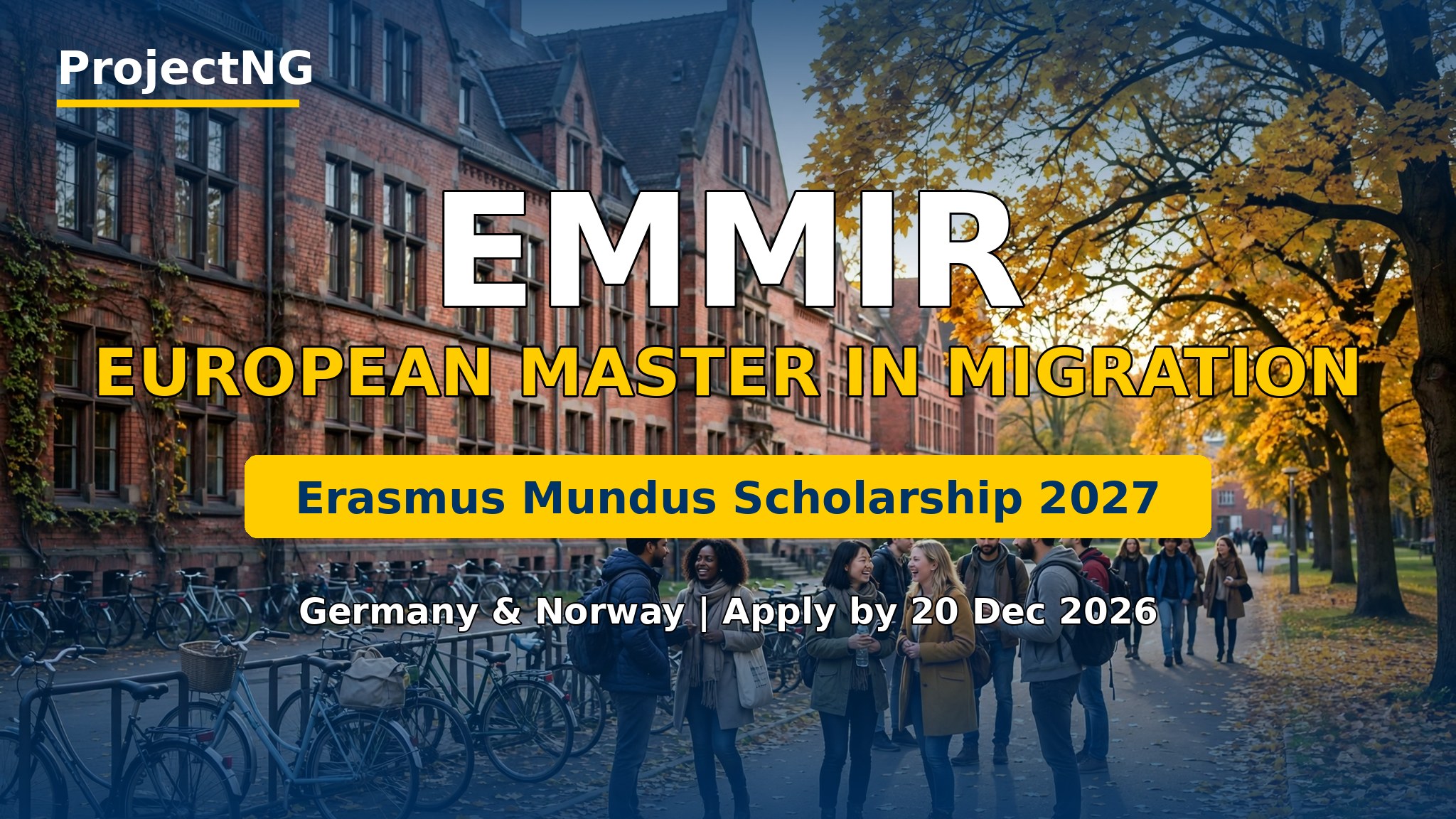
Erasmus Mundus Emmir Scholarship 2027: Migration Master's In Germany And Norway
Applications are now open for the Erasmus Mundus EMMIR Scholarship 2027, the European Master in Migration and Intercultural Relations, and the deadline is 20 December 2026 at 23:59 CET. This two-year joint master’s degree, starting 1 September 2027, takes students across Europe, Africa and Asia to study migration from different disciplinary, regional and cultural angles. A very limited number of Erasmus+ scholarships are available for Edition 14, so this is one to act on now, not in December.
2026 International Student Financial Guide
Securing a Fully Funded Scholarship is only the first step. Many Nigerian students are now utilizing No-Cosigner Student Loans through providers like MPOWER Financing and Prodigy Finance to cover living expenses in the USA, Canada, and the UK.
Proof of Funds & GRE Waivers
If you are applying to Ivy League or Russell Group Universities, look for programs offering Graduate Assistantships. Many top-tier universities are currently granting GRE and GMAT Waivers for African applicants with strong professional backgrounds or high GPAs from recognized institutions.
WES Evaluation and English Tests
For Canada and the US, a WES Course-by-Course Evaluation is often mandatory. Additionally, if your degree was taught in English, you may qualify for an IELTS/TOEFL Waiver, saving you significant costs during the Graduate Admissions process.
EMMIR is coordinated by the University of Oldenburg in Germany, working with the University of Stavanger in Norway and a consortium of nine partner institutions across Europe, Africa and Asia. Students spend their first semester in Oldenburg, their second in Stavanger, and their third semester at a partner university of their choice, with partner locations including Ghana and Uganda. The programme has already brought together 360 students and alumni from 89 countries over 16 years.
EMMIR Scholarship 2027: Key Facts at a Glance
- Programme: European Master in Migration and Intercultural Relations (EMMIR), Edition 14, 120 ECTS over two years
- Starts: 1 September 2027
- Host universities: University of Oldenburg (Germany), University of Stavanger (Norway), plus a partner university of your choice in semester three
- Scholarship deadline: 20 December 2026 at 23:59 CET, for Erasmus Mundus scholarship and non-fee-paying self-funded places
- Fee-paying self-funded deadline: 15 July 2027, subject to available places
- Funding: A very limited number of Erasmus+ scholarships; participation costs cover all obligatory programme activities and health insurance
- Results: Selection Board meets at the end of March 2027, with notification letters from the beginning of April 2027
What the EMMIR Scholarship Covers
EMMIR states clearly that only a very limited number of Erasmus+ scholarships are available, and it does not publish a monthly allowance figure, so applicants should not expect a fixed amount to be quoted in advance. What the programme does confirm is that participation costs cover all obligatory programme activities and health insurance, including the hosting university’s registration and student service fees. Room and board, other living expenses and travel are not included in the participation costs.
Students who apply as self-funded, whether fee-paying or non-fee-paying, should also plan their finances carefully. The programme notes that non-fee-paying and fee-paying students who need a student visa for Germany will have to show €11,208 in a blocked bank account for their first year of living expenses. Previous EMMIR students have also been financed through national grants and loans in their home countries, and the EMMIR team can provide documents to support third-party funding applications once a notification letter has been received.
Who Can Apply for EMMIR 2027
The most important eligibility rule is also the strictest. To be considered for the Erasmus Mundus scholarship or a non-fee-paying place, your first degree must be completed, with a final grade documented, by 20 December 2026. The programme states plainly that no exceptions can be made. A preliminary transcript showing your final grade and confirming that you completed the degree is accepted, and the final diploma itself must be presented by the time of enrolment. Final-year students who are still studying on 20 December cannot be considered for the scholarship, though fee-paying self-funded applicants may submit their diploma up to three months after the programme starts.
Applicants who have already benefited from an Erasmus Mundus scholarship before cannot apply for another one. Beyond that, EMMIR welcomes graduates from all countries and disciplines who can show knowledge of migration studies, intercultural relations and empirical methods, through modules completed, papers, essays or examinations. The programme does not set a single nationality or subject restriction, and its students come from 89 countries.
Documents You Need for the EMMIR Application
All documents must be uploaded as PDFs in English, or in the original language with an official English translation. Prepare these before you start:
- A clear copy of a valid passport
- Your CV
- A statement of purpose explaining your motivation to study EMMIR, maximum one to two pages
- Your first university degree diploma and transcript, plus any other relevant degrees
- Documentation of language proficiency
- Any other relevant documentation
Two details catch applicants out. First, do not upload reference letters: EMMIR asks only for the email addresses of referees, academic or professional, and contacts them directly. Second, the online form asks you to document your knowledge in the field in no more than 480 characters, so write that section tightly. The EMMIR team also warns that its system is not compatible with email providers from the Outlook family, including Hotmail and Outlook, so use Gmail, Yahoo Mail or another provider for all communication about your application.
How to Apply for the EMMIR Scholarship 2027
Applications are made online through the eMundus platform. Follow these steps:
- Register on eMundus using your name and email address, then open the online application form.
- Complete every section in English, entering your full name exactly as it appears in your passport, and save your progress as you go.
- Choose your funding options in the form: Erasmus+ scholarship student, non-fee-paying self-funded student, or fee-paying self-funded student. Your choice does not affect how your application is rated.
- Upload your documents as PDFs and add your referees’ email addresses.
- Submit before 20 December 2026 at 23:59 CET. EMMIR advises submitting at least 48 hours early, because only the timestamp in its database counts, and a submission registered after 23:59 CET will not be considered for the scholarship or a non-fee-paying place.
After submission you will receive a confirmation email. The EMMIR Selection Board meets at the end of March 2027, and successful applicants receive notification letters from the beginning of April 2027. If you are offered a place, you have 10 calendar days to send certified true hard copies of your documents, with proof of dispatch, and the aim is to complete preliminary admission for scholarship and non-fee-paying students by 30 April 2027.
Apply Now for EMMIR Edition 14
With the deadline falling on 20 December and the completed-degree rule leaving no room for late finishers, the strongest move is to start the eMundus application this week and gather certified documents early. Read the full application procedures on the official EMMIR application procedures page, check the funding options on the official EMMIR costs and funding page, and submit your application through the EMMIR eMundus application platform. You can also explore the programme on the official EMMIR website. For questions not covered on the website, email the EMMIR team at emmir(at)uol.de.
Be the First to Share On Social




RELATED SCHOLARSHIPS
Notre Dame Merit Scholarships 2027: Stamps Full TuitionScholarships For Study Abroad Programs
Unicaf $5 Million Worth Of Scholarships, A Golden Opportunity For Nigerian Students
Best Scholarships For Master’s In Canada
Macalester Turck Scholarship 2027: Up To $40,000/year
Dundee Global Excellence Scholarship 2027: £8,000 Uk
Honoring The Legacy Of Kate Szuberla Jauch: The Kate Szuberla Jauch Scholarship
Edinburgh Doctoral College Scholarships 2027: Phd Uk
How To Write A Personal Statement For Scholarships
Ptdf Scholarship: A Fully Funded Opportunity To Study Petroleum Engineering Abroad
12
Enjoying our content?
Don't miss out on new videos! Subscribe to our YouTube channel for more awesome content.
Subscribe Now!