
Erasmus Mundus Planthealth Scholarship 2027: €1,400 Monthly Grant For Plant Health Master's In Spain, Italy, Germany And France
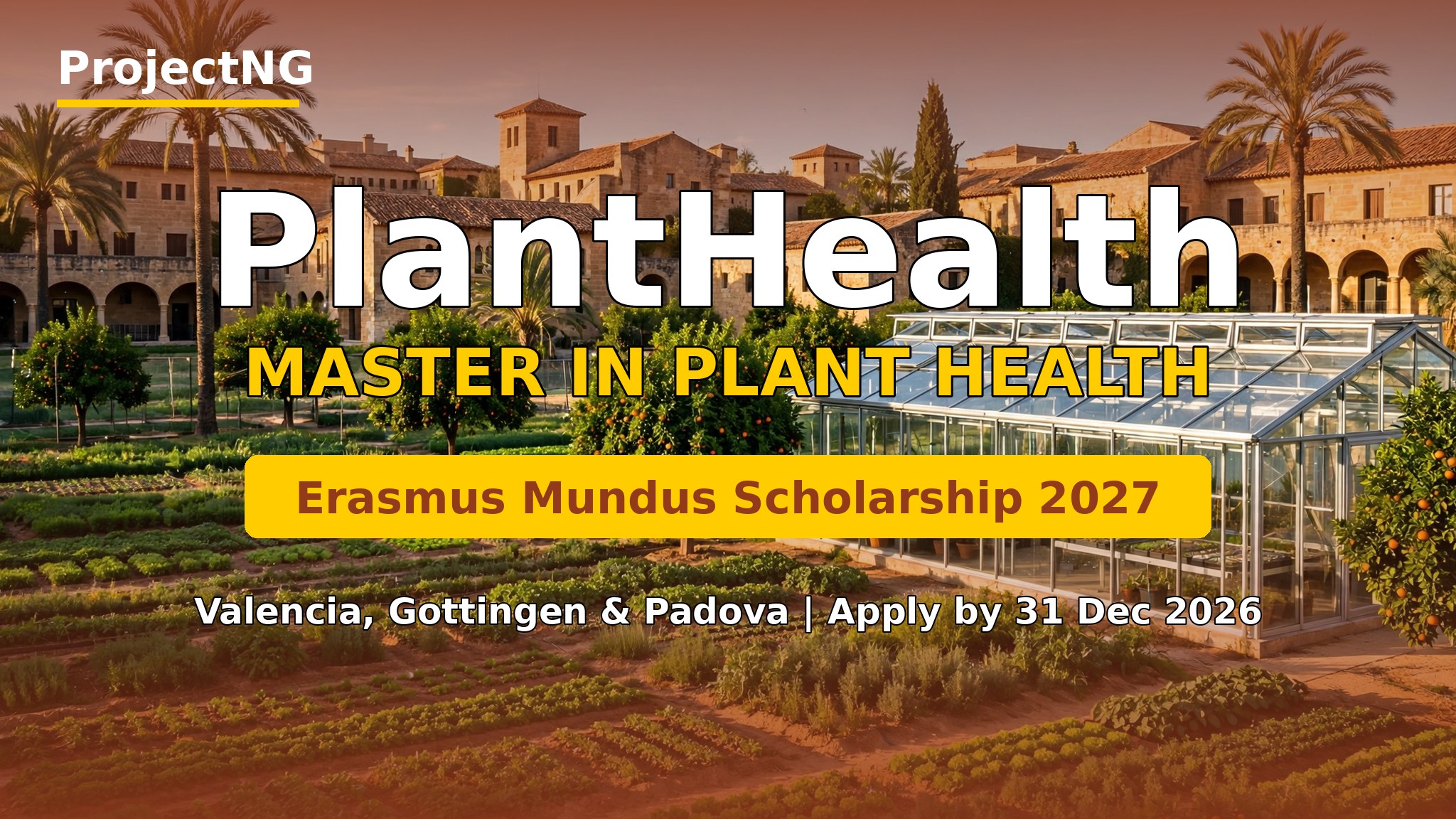
If your first degree is in agronomy or agriculture and you want a funded master's that takes you across Europe to study how crops stay healthy, the Erasmus Mundus PlantHealth Scholarship 2027 is worth a serious look. PlantHealth is the Erasmus Mundus Master Degree in Plant Health in Sustainable Cropping Systems, a two-year joint master's run by five universities in Spain, Italy, Germany and France, and the scholarship covers all of your participation costs and pays €1,400 a month for up to two years. Applications for the scholarship close on 31 December 2026, and only applications submitted in the first call, from 1 October to 31 December, are considered for the scholarship. This article explains what the programme is, who it suits, what it pays and how to apply.
2026 International Student Financial Guide
Securing a Fully Funded Scholarship is only the first step. Many Nigerian students are now utilizing No-Cosigner Student Loans through providers like MPOWER Financing and Prodigy Finance to cover living expenses in the USA, Canada, and the UK.
Proof of Funds & GRE Waivers
If you are applying to Ivy League or Russell Group Universities, look for programs offering Graduate Assistantships. Many top-tier universities are currently granting GRE and GMAT Waivers for African applicants with strong professional backgrounds or high GPAs from recognized institutions.
WES Evaluation and English Tests
For Canada and the US, a WES Course-by-Course Evaluation is often mandatory. Additionally, if your degree was taught in English, you may qualify for an IELTS/TOEFL Waiver, saving you significant costs during the Graduate Admissions process.
What is the PlantHealth master's?
PlantHealth is a two-year, 120-credit Erasmus Mundus Joint Master that trains graduates to manage plant health in sustainable cropping systems, from crop protection and pest management to the food safety questions that follow from them. The programme carries the Erasmus Mundus quality label and is recognised as a European master of excellence in plant health. You study in two different countries and graduate with a double diploma. The consortium is led by the Universitat Politecnica de Valencia in Spain, with AgroParisTech and Institut Agro in France, the University of Gottingen in Germany and the University of Padova in Italy. Teaching is in English and French, and the programme starts in September 2027.
Is the PlantHealth scholarship for you?
This scholarship suits you if you already hold, or are finishing, a bachelor's degree in agronomy, agriculture or a closely related field. The official admission page asks for a degree of at least 180 ECTS and, importantly, at least 4 ECTS specifically in Plant Health or Crop Protection, so check your transcript for that before you apply. You also need English at B2 level, and the programme accepts IELTS, TOEFL, CAE, CPE, FCE, ISE, ESOL, OTE or PTE. It does not accept Duolingo or TOEIC, and it does not accept certificates issued by universities or private language academies, so do not rely on a letter from your own university unless you completed your whole degree in English. Native English speakers, and graduates whose whole degree was taught in English, are exempt, provided they can show an official certificate from their home university.
Final-year students can apply, as long as they finish their degree before the end of August 2027. If you do, you will need a university certificate confirming your final-year enrolment and your expected graduation date, plus your most recent transcript. Be aware that your selection will be cancelled if you have not completed your studies before the programme begins in September. One hard rule to note: if you have already held an Erasmus Mundus Joint Master scholarship, you cannot apply for another one, and you cannot hold another EU grant at the same time as this scholarship.
What the scholarship covers
The Erasmus Mundus scholarship is generous and clearly set out on the official UPV admission page. It covers 100 percent of the participation costs, which would otherwise be €9,000 for EU, EEA and Swiss students and €10,000 for students from other countries. It also covers comprehensive health insurance and all mandatory academic costs, and it pays a monthly stipend of €1,400 a month for up to 24 months, intended for travel, visa, installation and living expenses. Extra scholarships with the same coverage are often reserved for students from specific priority regions. The programme also offers PlantHealth Consortium scholarships in the first round only, and self-funded students can apply for a non-means-tested Erasmus+ grant of around €300 a month in their second year, though the official page is clear that this is a top-up and not enough to live on.
How applications are judged
There is no separate scholarship form. One application covers both admission and the scholarship, and the selection committee scores it on three things: your academic record and merits, worth 60 percent, your reference letters, worth 20 percent, and your personal motivation, worth 20 percent. Your grades matter most, so a strong transcript is the foundation of your application. Your two reference letters should come from university professors or employers who know your work, and they must be signed, stamped and include the issuer's contact details. Your statement of purpose is short, a maximum of 1,000 characters including spaces, so every sentence has to earn its place. Selected candidates are notified through the official master's platform, following the established calendar published there.
Documents you need to prepare
Get everything ready in digital format before you start the form, because applications are managed exclusively online and anything sent by post or email will not be accepted. You will need:
- Your bachelor degree, showing at least 180 ECTS in agronomy, agriculture or a related field, with at least 4 ECTS in Plant Health or Crop Protection.
- Your official transcript of records for your bachelor degree, plus transcripts for any postgraduate study you have done.
- Proof of English at B2 level from one of the accepted exams listed above.
- Two letters of recommendation, signed by university professors or employers, with contact details and the official stamp of the issuing institution.
- Your CV, preferably in Europass format.
- A statement of purpose of no more than 1,000 characters, entered in the online form.
- If you are still in your final year, a university certificate confirming your enrolment and expected graduation date.
If you are admitted, the university will send you personalised instructions on translating and legalising your documents, because the requirements vary by host university. Proof of residence is only required later, for students who are finally selected.
How to apply before 31 December 2026
Applications are made only through the official PlantHealth online platform. The first call runs from 1 October to 31 December 2026, and only applications received in this period are considered for an Erasmus Mundus scholarship. The official page does not state a closing time, so treat 31 December as the last day and apply well before it, not on the final evening. A second call runs from 20 May to 15 June 2027, but that round is for self-funded students only, with no Erasmus Mundus scholarships available, so the December deadline is the one that matters for funding.
When you apply, answer the preliminary requirements question in the form honestly, upload every document through the portal, and double-check that your degree shows the required 4 ECTS in plant health or crop protection. Applications submitted outside the call periods, or through any route other than the official form, will not be accepted.
Why PlantHealth is worth your application
Food security depends on healthy crops, and this programme trains you in exactly that, across five leading European universities, with field trips, internships and a thesis that can be carried out with a company. Graduates work in the global plant health sector, and the programme reports a high rate of employment for its alumni. With full participation costs covered, health insurance included and €1,400 a month for two years, the scholarship removes the financial barrier for the strongest candidates. If your degree and your English meet the requirements, and you can show those 4 ECTS in plant health, the next step is the official application page below. Apply before 31 December 2026.
Apply now
Read the full admission requirements and submit your application through the official channels below:
Be the First to Share On Social




RELATED SCHOLARSHIPS
Dayton Merit Scholarships 2027: Up To $34,000 A YearBoston University Presidential Scholarship 2027 In Usa
Wieland Nurse Appreciation Scholarship: Honoring And Supporting Nursing Excellence
Washu Signature Scholar Programs 2027: Full Tuition
How To Find The Best Scholarships For Your Education
Scholarships For Lgbtq+ Students
Best Scholarships For Master’s In Canada
Warwick Postgraduate Research Scholarships 2027 In Uk
Erasmus Mundus Europubhealth+ Scholarship 2027: €1,400 Monthly Grant For A Public Health Master's Across Europe
Melbourne International Scholarship 2027: 20% Off Fees
22
Enjoying our content?
Don't miss out on new videos! Subscribe to our YouTube channel for more awesome content.
Subscribe Now!