
Erasmus Mundus Globe Scholarship 2027: €1,400 Monthly Grant For Global Change Ecology Master's In Spain, Wales And Portugal
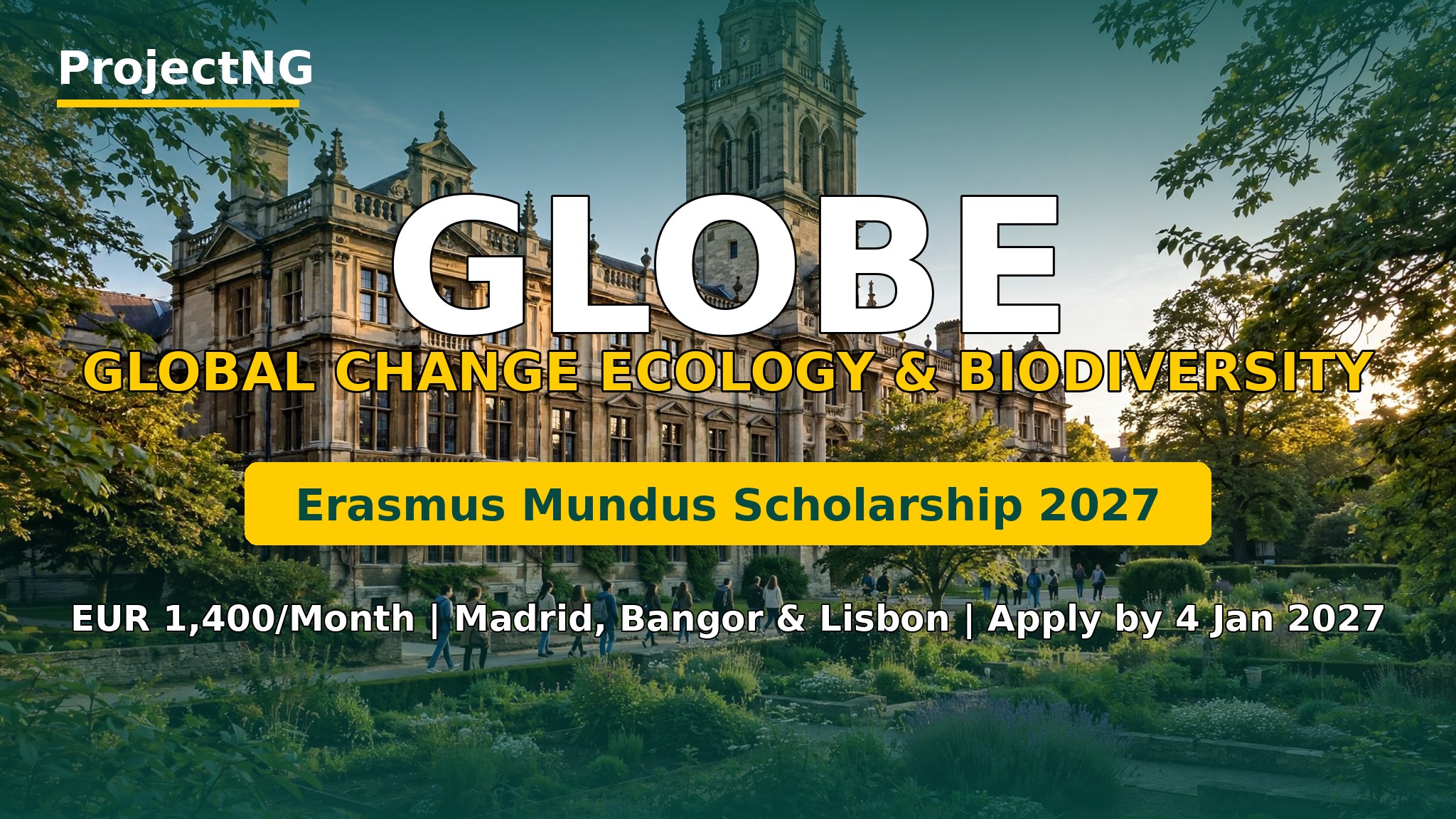
If your first degree is in biology, environmental science or a related field, and you want a funded master's that trains you to work on climate change and biodiversity loss, the Erasmus Mundus GLOBE Scholarship 2027 is worth a serious look. It pays €1,400 a month for 24 months, covers all your participation fees, and takes you to three universities in Spain, Wales and Portugal, with a summer school in Mexico. The first stage of the application closes on 4 January 2027, and this article explains in plain terms what GLOBE is, who it suits, what it pays for, and exactly how to apply.
2026 International Student Financial Guide
Securing a Fully Funded Scholarship is only the first step. Many Nigerian students are now utilizing No-Cosigner Student Loans through providers like MPOWER Financing and Prodigy Finance to cover living expenses in the USA, Canada, and the UK.
Proof of Funds & GRE Waivers
If you are applying to Ivy League or Russell Group Universities, look for programs offering Graduate Assistantships. Many top-tier universities are currently granting GRE and GMAT Waivers for African applicants with strong professional backgrounds or high GPAs from recognized institutions.
WES Evaluation and English Tests
For Canada and the US, a WES Course-by-Course Evaluation is often mandatory. Additionally, if your degree was taught in English, you may qualify for an IELTS/TOEFL Waiver, saving you significant costs during the Graduate Admissions process.
What Is the GLOBE Scholarship?
GLOBE is the Erasmus Mundus Joint Master in Global Change Ecology and Biodiversity Management, a two-year, 120 ECTS master's taught entirely in English. It is coordinated by Universidad Rey Juan Carlos in Madrid, Spain, with Bangor University in Wales and Universidade de Lisboa in Portugal as the other degree-awarding partners. Students study in Madrid, Bangor and Lisbon, take part in a summer school at the Universidad Autonoma de Tlaxcala in Mexico, and complete a 25 ECTS master's thesis in the final semester at one of the partner universities or an associated partner. Graduates receive multiple master's degrees from the three main partner institutions.
The programme trains students to understand how global change affects biodiversity, and to turn that knowledge into practical conservation and environmental management. The courses cover biodiversity and ecosystem functioning, conservation genetics, wildlife conservation techniques, environmental assessment, environmental governance and the move towards a bioeconomy. Graduates go on to PhD study, or to work in government agencies, NGOs, environmental consultancies, research and education.
What the GLOBE Scholarship 2027 Covers
Erasmus Mundus Joint Master scholarships are awarded on a competitive basis to a subset of the students selected for admission. If you are awarded one, it covers the full 24 months of the programme and provides:
- €1,400 per month for living costs, accommodation, travel and other expenses, for 24 months
- All participation fees covered, including tuition, registration at the partner universities, health and accident insurance, and all academic activities including the summer school
There is no application fee for GLOBE. Students who have already held an Erasmus Mundus Joint Master scholarship in the past are not eligible for another one. All nationalities are eligible to apply for a scholarship.
Is the GLOBE Scholarship for You?
GLOBE suits you if you hold, or are about to complete, a bachelor's degree of at least 180 ECTS in a relevant field. The qualifying degrees listed on the official application page are biology, agriculture or environmental sciences, forestry, earth and environmental geography, and natural resources, or an equivalent bachelor's degree. Candidates from other disciplinary backgrounds are encouraged to apply, as long as they can show academic excellence and a genuine passion for the ecological, social, economic and political challenges of environmental change.
You also need English at a minimum of B2 level, and you must meet that level by the Stage 1 deadline of 4 January 2027. The accepted proofs are IELTS with a minimum score of 5.5, TOEFL iBT with at least 72 points, or Cambridge with a minimum grade of B2 and a score of 160. Nationals of, or graduates from universities in, a majority English-speaking country as defined by UKVI are exempt. One point to take seriously: a Medium of Instruction certificate from your home university is not accepted as proof of English, so do not rely on one.
Only up to 25 students are recruited for the third edition, and scholarships go to a subset of those selected, so this is a competitive award. The selection is based on academic excellence, how well your degree fits the programme, your CV, a short motivation video and your referees' letters. If your background is in a relevant science and your grades are strong, you are exactly the kind of applicant GLOBE is looking for.
How the Two-Stage Application Works
GLOBE uses a two-stage application, and the first stage is deliberately simple. In Stage 1, which runs from 28 September 2026 to 4 January 2027, you fill in an online form only. No supporting documents are required at this point. You provide your personal details, your academic data (degree name, year, university, field and GPA), your English proficiency details, a link to a one to two minute video introducing yourself and explaining your motivation, and the contact details of two referees. Your referees are contacted only if you advance to the next stage.
In Stage 2, in January and February 2027, shortlisted applicants are invited to submit supporting documents. These include a valid passport, an authenticated copy of your degree certificate, your full transcript of records, official proof of English, a Europass CV, a declaration of veracity, and, if your home university is outside the European Higher Education Area, a Postgraduate Eligibility Certificate from your university. Stage 1 counts for 77 percent of the total score (fit to the programme 10 percent, academic excellence 35 percent, CV 32 percent), and Stage 2 counts for 23 percent (video 15 percent, reference letters 8 percent). You need at least 50 out of 77 points to pass Stage 1. After the final ranking, successful candidates have seven days to confirm their intention to enrol.
Documents to Prepare
Even though Stage 1 asks for no documents, it is sensible to start gathering the Stage 2 documents now, so a shortlisting does not catch you unprepared:
- A valid passport, valid for the full two years of the programme
- An authenticated copy of your bachelor's degree certificate, with a sworn English translation if needed
- Your complete transcript of records in English, showing courses, grades and credit units
- Official proof of English at B2 level (IELTS 5.5, TOEFL iBT 72, or Cambridge B2/160)
- A CV in Europass format
- Contact details for two referees who can comment on your suitability
- A one to two minute motivation video, recorded before you submit Stage 1
- A Postgraduate Eligibility Certificate if your university is outside the European Higher Education Area
Make sure the grades and details you declare in Stage 1 match your documents exactly. The official page states that applicants with inconsistencies between their declared data and their official documents will be automatically rejected.
How to Apply for the GLOBE Scholarship 2027: Step by Step
Step 1: Read the official application page. Check the full rules on the official GLOBE application page, and read the GLOBE programme page to confirm the degree, the mobility and the learning outcomes match what you want.
Step 2: Confirm your English result. Make sure you hold, or will hold by 4 January 2027, an accepted English certificate at B2 level. Remember that a Medium of Instruction certificate is not accepted.
Step 3: Record your motivation video. Prepare a one to two minute video introducing yourself and explaining why you want to join GLOBE. This counts for 15 percent of your total score, so keep it clear, specific and honest.
Step 4: Ask your two referees. Choose referees who know your academic work well, such as lecturers or employers, and confirm they are willing to be contacted. They are only contacted if you reach Stage 2.
Step 5: Submit the Stage 1 online form before 4 January 2027. Complete the form on the official GLOBE application page, using a personal email address you will keep throughout the process, and double check every grade and detail before you submit. The official page publishes the date only, with no closing time, so do not leave your submission to the final hours. If you submit more than one application, only the most recent one is considered.
Step 6: Prepare your documents for Stage 2. If you are shortlisted in January or February 2027, submit your passport, authenticated degree, transcript, English proof, Europass CV and other documents through the Stage 2 platform, then wait for the final ranking and your scholarship decision.
Important Dates for the GLOBE Scholarship 2027
- Stage 1 applications opened: 28 September 2026
- Stage 1 deadline: 4 January 2027 (date only, no closing time published)
- Stage 2 (shortlisted applicants only): January to February 2027
- Programme starts: September 2027
If biodiversity and global change are the problems you want to spend your career working on, GLOBE offers funded study in three countries, a summer school in Mexico, and a monthly allowance that covers your living costs. Start your Stage 1 form now, record your video, and submit through the official GLOBE application page well before 4 January 2027. For the full rules, see the GLOBE application page and the GLOBE programme website.
Be the First to Share On Social




RELATED SCHOLARSHIPS
Sheffield Ncuk Merit Scholarship 2027: Up To £17,500How To Write A Scholarship Thank You Letter
Scholarships For Women In Business
Cambridge Trust International Scholarships 2027: Phd
Western National Scholarship Program 2027: $100,000
Chevening Scholarship 2026: Step-by-step Guide
University Of Kansas Scholarships 2027: Up To $64,000 For Students
How To Apply For Commonwealth Scholarships
Online Masters Degree Uk
Canada Study Grant For International Students
8
Enjoying our content?
Don't miss out on new videos! Subscribe to our YouTube channel for more awesome content.
Subscribe Now!