
Ens International Selection Scholarship 2027: €1,000 Monthly Grant In Paris, France
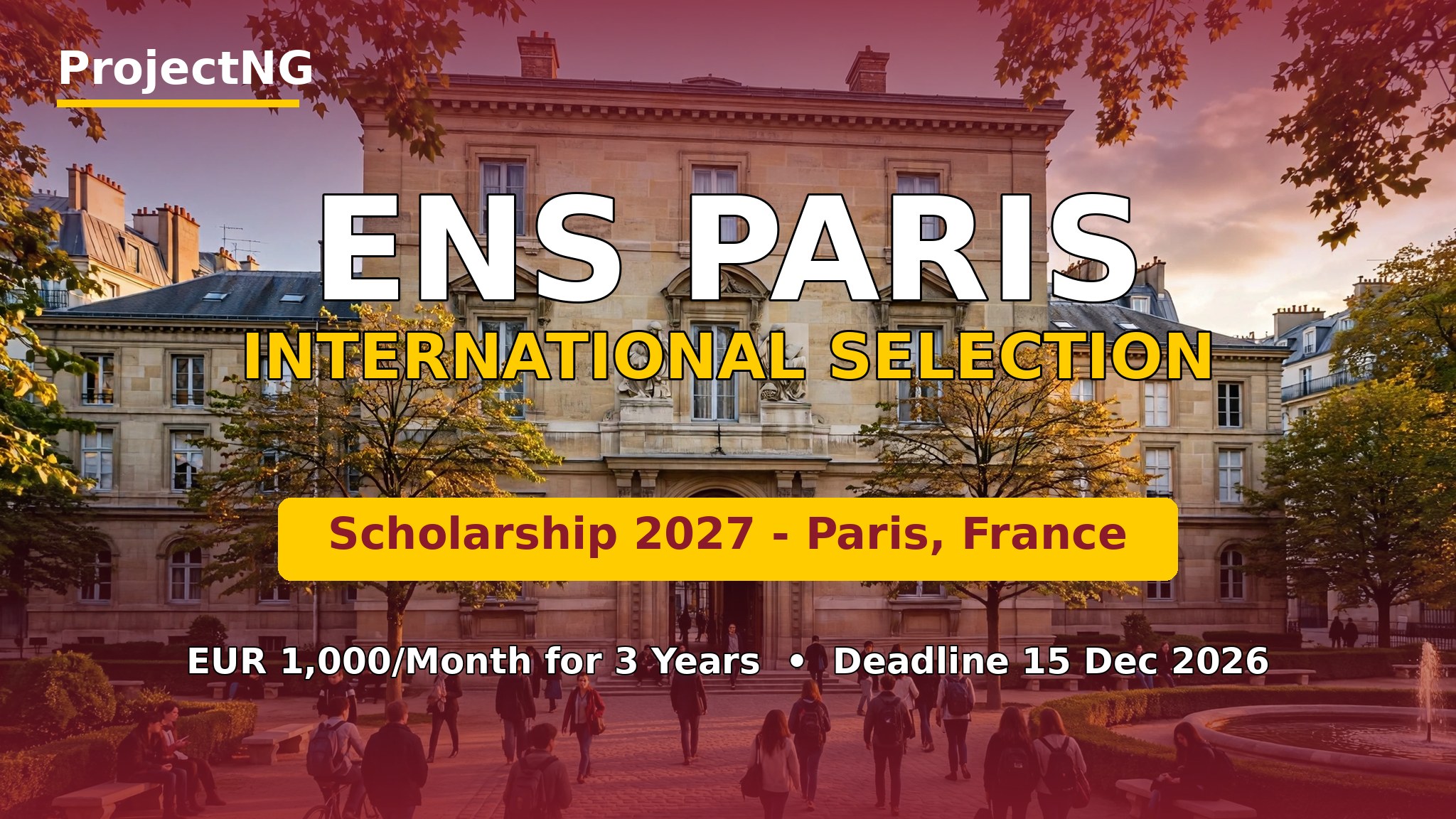
The ENS International Selection Scholarship 2027 is open, and it is one of the most direct routes into a world-class education in the heart of Paris. The Ecole normale superieure - PSL is offering around 20 places for outstanding international students to spend three years studying in the Latin Quarter, with a monthly grant of EUR 1,000 for 36 months and a furnished room on an ENS campus. Applications close on 15 December 2026 at 2:00 p.m. Paris time, and both tracks, Arts and Humanities and Sciences, share that same deadline.
2026 International Student Financial Guide
Securing a Fully Funded Scholarship is only the first step. Many Nigerian students are now utilizing No-Cosigner Student Loans through providers like MPOWER Financing and Prodigy Finance to cover living expenses in the USA, Canada, and the UK.
Proof of Funds & GRE Waivers
If you are applying to Ivy League or Russell Group Universities, look for programs offering Graduate Assistantships. Many top-tier universities are currently granting GRE and GMAT Waivers for African applicants with strong professional backgrounds or high GPAs from recognized institutions.
WES Evaluation and English Tests
For Canada and the US, a WES Course-by-Course Evaluation is often mandatory. Additionally, if your degree was taught in English, you may qualify for an IELTS/TOEFL Waiver, saving you significant costs during the Graduate Admissions process.
Selected students join ENS-PSL as normaliens for three years of study, completing a Master's degree and the ENS graduate degree. The programme is research-led from the start, with a personal tutor, small-group teaching and time in laboratories or seminars alongside some of the best researchers in France. There is no separate scholarship form and no separate scholarship deadline. You apply once, through the International Selection, and the grant comes with admission.
ENS International Selection Scholarship 2027 at a glance
- Host: Ecole normale superieure - PSL (ENS-PSL), Paris, France
- Level: Three years of study leading to a Master's degree and the ENS graduate degree
- Grant: EUR 1,000 per month for 36 months, plus a furnished room on an ENS campus
- Places: Around 20 a year, about ten in Sciences and ten in Arts and Humanities
- Deadline: 15 December 2026 at 2:00 p.m. Paris time, both tracks
- Start date: September 2027
- Selection rate: Between 5 and 10 percent
What the ENS International Selection Scholarship covers
The grant is EUR 1,000 a month for 36 months, confirmed on the official ENS FAQ. It is a study grant, not a salary, so students admitted through the International Selection do not become civil servants and are not bound by the ten-year public service commitment that applies to some French normaliens. The first payment arrives in October 2027 and covers September and October together. After that, payments land monthly between the 5th and the 10th.
Admitted students can also ask for a furnished room on an ENS campus. In the first year students are usually housed on rue d'Ulm, and in the following two years accommodation may be on one of the three ENS campuses at rue d'Ulm, boulevard Jourdan or Montrouge. The official FAQ says the rent amount is still to be announced, so do not budget on an old figure. In French public universities, tuition fees are paid by the State, but students still pay registration fees.
Students may ask for up to two gap years during their studies, but the grant is not paid during a gap year or a gap semester. If you are selected, you must enrol in a Master's programme and in the ENS graduate degree, which requires 72 extra credits on top of your Master's credits over the three years.
Who can apply for the ENS International Selection 2027
Both tracks share the same core rules. You must be under 26 on 16 October 2026, the day applications opened. You must never have applied to the International Selection before. And you must not have spent too much recent time in France: Arts and Humanities candidates must not have resided in France for more than 10 months during the competition year or the preceding academic year, while Sciences candidates must not have been registered in a French school or higher education institution for more than 6 months in total over those two years.
Arts and Humanities: You must provide proof of at least three years of study towards a foreign university degree, in the form of complete transcripts for all your university coursework. You may apply if you are currently in your third year. For studying Arts and Humanities, ENS recommends that you are fluent in French. The official FAQ puts the working level at B1, and no official language certificate is required. Courses are taught in French, and the motivation letter and research project must be written in French. Candidates in Economics, Linguistics or Cognitive studies may submit those documents in English.
Sciences: You must justify at least one year of undergraduate study awarded by a foreign university, and at least two years of undergraduate study by the time you enrol. Teaching is in French or in English, depending on the department, and no language level is officially required. During the interviews, you may answer in French or in English.
Disciplines you can apply for
Sciences: Biology, Chemistry, Earth Science, Computing Science, Mathematics, Physics and Cognitive Sciences. You choose one single discipline.
Arts and Humanities: Anthropology, Archaeology, Classical Studies (Greek, Latin), Cinema, Theatre Studies, History of Art, Musicology, Cognitive Sciences, Economics, Political Studies, Geography, History, History and Philosophy of Law, History and Philosophy of Sciences, Linguistics, Literature, Philosophy and Sociology. Again, you choose one single discipline.
Documents you will need
Arts and Humanities:
- Curriculum vitae
- Motivation letter, 1 to 3 pages, Times New Roman 12 pt, 1.5 line spacing, written in French (Economics, Linguistics and Cognitive studies candidates must submit it in both French and English)
- Research project of 3 pages maximum (10,000 characters including spaces), with a bibliography of 10 books, articles or literary works that have mattered in your intellectual career, written in French (Economics, Linguistics and Cognitive studies candidates may write it in French or in English)
- University transcript
- High school diploma
- Two to four letters of recommendation, requested directly through the OnePSL30 platform
Sciences:
- High school diploma
- University transcript
- Curriculum vitae
- Argued cover letter of 1 to 3 pages, in French or English, explaining your interest in joining ENS and your chosen department, and presenting your study plan
- Two to four letters of recommendation, requested directly through the OnePSL30 platform
For Sciences, all documents must be merged into a single PDF on the platform. For both tracks, an incomplete application will not be taken into consideration, so check every document before you submit. Do not use an @icloud.com email address for yourself or for your referees.
How to apply for the ENS International Selection Scholarship 2027
Step 1: Read the official International Selection page and the official FAQ on the ENS-PSL website, and confirm which track and discipline fits your background.
Step 2: Prepare your documents early, and contact your referees well before the deadline. They must submit their letters through the platform, and ENS advises against leaving this to the last few days.
Step 3: Create your application on the OnePSL30 application platform and upload all required documents there. No applications are accepted by email or by post.
Step 4: Submit before 15 December 2026 at 2:00 p.m. Paris time. That is a hard cut-off for both tracks, so aim to submit at least a day early.
Step 5: Watch for the shortlist. Arts and Humanities shortlist results come from 21 January 2027, and Sciences shortlist results from 27 January 2027. All candidates receive an email either way.
Step 6: If you are shortlisted, sit the tests by videoconference. Arts and Humanities tests run between 15 and 26 February 2027 and include a written test in French, an oral test in your discipline and an interview about your background and project. Sciences tests run between 3 and 19 March 2027 and include a scientific oral test and an interview on your scientific culture and motivation. Admission results follow from 9 March 2027 for Arts and Humanities and from 26 March 2027 for Sciences.
Why this scholarship is worth your time
ENS-PSL sits in the Quartier Latin, in the very heart of Paris, and it is one of the most selective graduate schools in France. The International Selection is small and competitive, with only around 20 places a year, but it is also unusually open: there is no nationality restriction, no application fee mentioned on the official pages, and no requirement to hold a separate offer before you apply. If you are under 26, have at least three years of university study behind you (or are in your third year), and can show real curiosity and research potential, this is a genuine chance to study in Paris with a steady monthly grant for three years.
Do not wait for the deadline week. The research project and the reference letters take time, and the platform closes at 2:00 p.m. Paris time on 15 December 2026, not at midnight. Start your application now on the OnePSL30 application platform, and check every detail against the official ENS-PSL International Selection page and the official ENS-PSL FAQ about International Selection.
Be the First to Share On Social




RELATED SCHOLARSHIPS
How To Write A Scholarship Thank You LetterBest Scholarships For Master’s In Canada
Barry Stamps Scholars Program 2027: Full Tuition Usa
Monash International Merit Scholarship 2027: $15,000
Calgary International Entrance Scholarship 2027 Canada
Western National Scholarship Program 2027: $100,000
The Ultimate Guide To Winning Scholarships
Birmingham High Fliers Scholarship 2027: £5,000 Uk
Cheapest Universities In London For International Students
Exeter Excellence Scholarships 2027: £15,000 A Year
9
Enjoying our content?
Don't miss out on new videos! Subscribe to our YouTube channel for more awesome content.
Subscribe Now!