
Epfl Master Excellence Fellowship 2027: Chf 10,000 Per Semester In Lausanne, Switzerland
Picture this. You are walking across a campus on the shore of Lake Geneva, the Alps on the horizon, on your way to a lecture at one of the best science and technology universities in Europe. Now picture doing it with CHF 10,000 landing in your account every semester. That is what the EPFL Master Excellence Fellowship offers, and the deadline for the 2027 intake is closer than you think.
2026 International Student Financial Guide
Securing a Fully Funded Scholarship is only the first step. Many Nigerian students are now utilizing No-Cosigner Student Loans through providers like MPOWER Financing and Prodigy Finance to cover living expenses in the USA, Canada, and the UK.
Proof of Funds & GRE Waivers
If you are applying to Ivy League or Russell Group Universities, look for programs offering Graduate Assistantships. Many top-tier universities are currently granting GRE and GMAT Waivers for African applicants with strong professional backgrounds or high GPAs from recognized institutions.
WES Evaluation and English Tests
For Canada and the US, a WES Course-by-Course Evaluation is often mandatory. Additionally, if your degree was taught in English, you may qualify for an IELTS/TOEFL Waiver, saving you significant costs during the Graduate Admissions process.
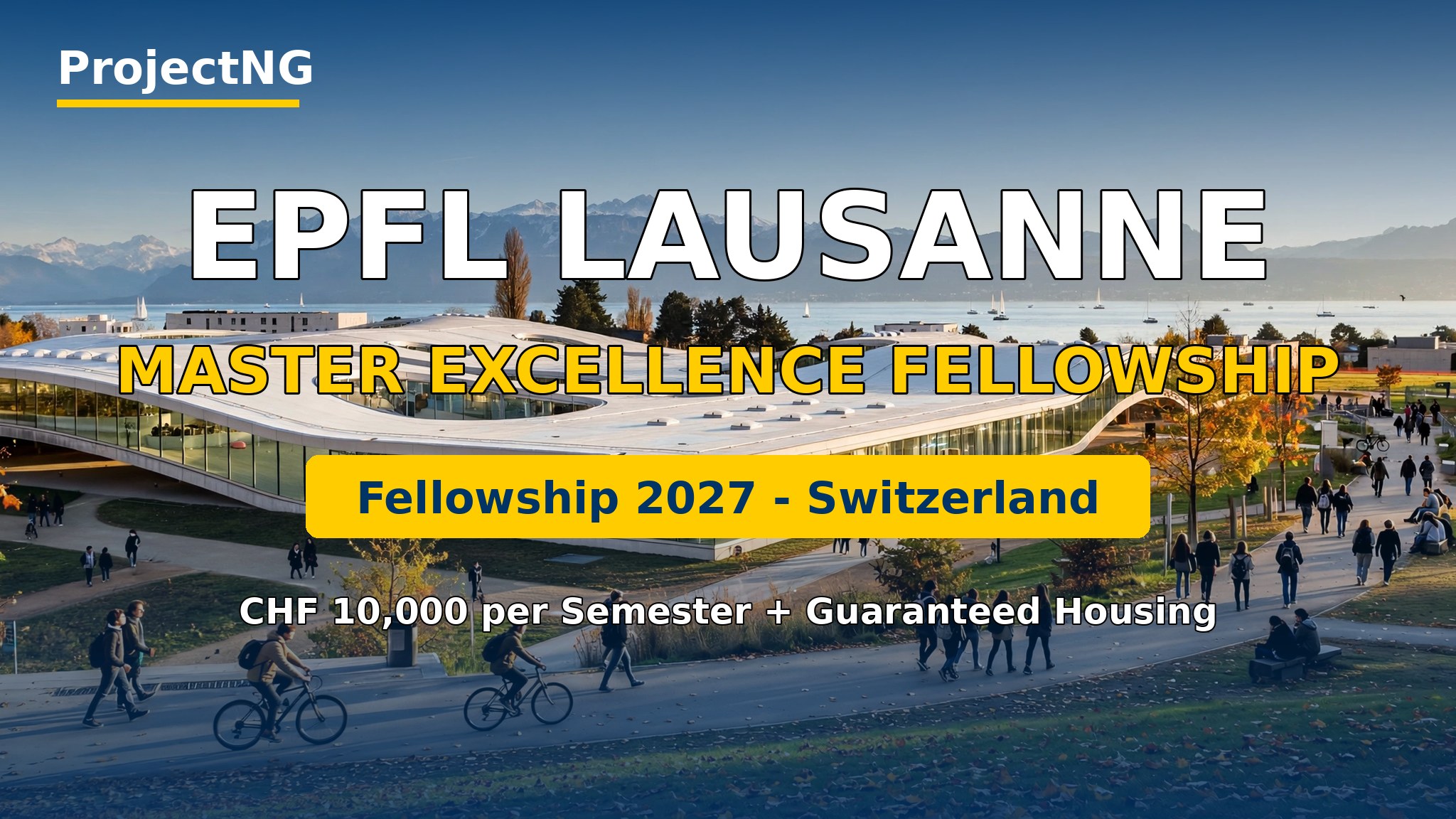
EPFL, the Swiss Federal Institute of Technology in Lausanne, gives a limited number of these fellowships every year to outstanding students starting a Master's degree. The award is worth CHF 10,000 per semester, for up to four semesters, which can add up to CHF 40,000 over the course of your degree. On top of the money, external candidates get a guaranteed room in a student residence, which in a city like Lausanne is worth almost as much as the cash itself.
But before you start celebrating, here is the honest part, and it matters. This is partial funding, not a fully funded scholarship. EPFL is clear about it: tuition fees, rent and living costs stay your responsibility. The fellowship is a generous contribution towards your studies, not a package that covers everything. If you go in with your eyes open, it is still one of the best Master's funding deals in Switzerland. Just do not call it fully funded, because it is not.
The deadline that decides everything: 15 December 2026
There are two deadlines, and which one applies to you depends on where you studied before.
- 15 December 2026: for external candidates applying through IS-Academia. Your Master's application must be paid for and validated by this date. Not submitted, not almost finished. Paid and validated.
- 31 January 2027: for EPFL Bachelor's students applying for a consecutive Master's degree in the same field.
Here is the part that catches people out every year. If your application is validated after 15 December, EPFL will still consider you for admission to the Master's programme. You will simply not be eligible for the fellowship. The date is the whole game, so treat 15 December as a hard stop and aim to be validated well before it.
Your referees get a little more time. Reference letters must be uploaded one week after the application deadline, and the exact date will be in the confirmation email you receive once your application is validated. For EPFL students on the January route, the recommendation letters are due by 31 January as well.
What the EPFL Master Excellence Fellowship actually gives you
It helps to see the whole package in one place, so you know exactly what you are applying for.
- CHF 10,000 per semester, paid into a Swiss bank or postal account at the start of each semester, for a maximum of four semesters. The fellowship covers two to three semesters of the Master's cycle depending on the programme, plus one semester for the Master's project.
- A reserved room in a student residence, for external candidates. You still pay the rent yourself, but you do not have to fight Lausanne's housing market on arrival.
- A certificate of excellence when you complete your Master's programme.
- Freedom to choose: EPFL says the funding is meant to let fellows pick internships and first work experiences according to their scientific interests, rather than according to what pays the bills.
What it does not cover is just as important. Tuition fees, rent and everyday living costs are yours to manage, and the fellowship cannot be combined with other substantial scholarships. If you hold other funding during your Master's, you must declare it.
Who can apply for the EPFL Master Excellence Fellowship?
The door is wider than many people expect. Anyone applying to a Master's programme at EPFL is eligible, whether you did your Bachelor's at EPFL or at another university anywhere in the world. EPFL offers 29 Master's programmes across its five schools and two colleges, and you may apply for only one Master's programme per year.
There are two exclusions to know about. You are not eligible if you already hold a Master's degree, or if you are already enrolled in a Master's programme at EPFL. Beyond that, selection is based on academic excellence, qualifications and motivation, and EPFL also looks at what you have done outside the lecture hall. Research, publications, prizes, entrepreneurship, start-ups, patents, and civic or community commitment all count. The fellowships reward students with remarkable academic results who also stand out in sporting, artistic, civic or entrepreneurial activities.
To keep the fellowship into your second year, you need to stay excellent. Renewal requires at least 50 ECTS credits in your first year and an overall average of 5.0 out of 6. EPFL states plainly that there are no exceptions to that rule.
What documents do you need?
One of the nicest things about this fellowship is how simple the application is. There is no separate scholarship form and no extra set of documents beyond what admission already asks for.
- The standard documents required for admission to your chosen EPFL Master's programme.
- Two recommendation letters from professors who know your work and achievements. These must be submitted directly by your referees.
- For EPFL students applying for a consecutive Master's: a CV, a motivation letter, a transcript of all grades earned at EPFL, and two recommendation letters, submitted directly to your section with a copy to the fellowship office.
After an initial screening by the sections, the Excellence Fellowships Committee makes the final awards. Selected candidates are notified in late March. If a selected candidate withdraws or does not respond, the fellowship goes to the next person on the waiting list.
How to apply, step by step
- Choose your programme. Pick one of EPFL's 29 Master's programmes and check its admission requirements on the official EPFL Master Excellence Fellowships page.
- Start your Master's application early. Apply through EPFL's online Master's application form via IS-Academia, and make sure you tick the box that says your profile should also be considered for an excellence fellowship. That tick is your fellowship application.
- Ask your referees now. Two professors need to upload recommendation letters, and they have one week after the deadline. Give them plenty of notice.
- Pay and validate by 15 December 2026. This is the step that decides fellowship eligibility. Do not leave payment or validation to the last day, because an application that is only submitted is not enough.
- Watch for your confirmation email. It confirms your validation and tells you the exact deadline for your reference letters.
- Wait for late March. That is when EPFL notifies the selected fellows.
If you are an EPFL Bachelor's student continuing in the same field, the route is slightly different: you apply directly to your section, with a copy to the fellowship office, by 31 January 2027, and you do not need to go through IS-Academia. Full details for both routes are on the official EPFL application and deadlines page.
Is the EPFL Master Excellence Fellowship for you?
Ask yourself three questions. First, are your grades genuinely outstanding, the kind that put you near the top of your class? Second, do you have something beyond grades, a project, a publication, a start-up, a community role, that shows who you are? Third, can you fund the rest, the tuition and the living costs in one of Europe's most expensive cities, with CHF 10,000 a semester plus a guaranteed room as your foundation?
If the answer to all three is yes, then this is a fellowship worth chasing, and 15 December is not far away. Start the application today, get your referees lined up, and give yourself the best possible shot at Lausanne.
For the full official details, see the EPFL Master Excellence Fellowships page and the application and deadlines page on EPFL's website.
Be the First to Share On Social




RELATED SCHOLARSHIPS
Masters Program In UkEth Zurich Excellence Scholarship 2027/28: Chf 13,500 Per Semester Plus Full Tuition Waiver In Switzerland
University Of Alabama Presidential Scholarship 2027 Usa
York International Undergraduate Scholarship 2027 In Uk
Flinders Vice Chancellor Scholarship 2027: 50% Off
American Dream Scholarship For Nurses The Healthcare Heroes
Waterloo International Entrance Scholarship 2027 Canada
Wake Forest Signature Scholarships 2027: Full Cost
Emory Scholar Programs 2027: Merit Scholarships Usa
Online Masters Degree Uk
5
Enjoying our content?
Don't miss out on new videos! Subscribe to our YouTube channel for more awesome content.
Subscribe Now!